Mom to Mia (6) and Theo (9). Freelance writer by trade, which
basically means I've always had an excuse to spend too much money
testing things and writing about them. Kids' stuff has been my
corner of that for a while now, and I share the honest version here.
The 5 Best Science Kit Subscription Boxes for Kids of 2026
My friend texted me last fall asking which
science subscription box to get her 7-year-old for
the holidays. I had absolutely no idea. KiwiCo existed, obviously, but
whether it was actually the best option for a 7-year-old, I couldn't
say.
So I bought five of them. Brought them all home, spread them across my
kitchen table, and spent the next four months testing every single one
with my two kiddos. Mia is 6 and Theo is 9 and they have very
different opinions about everything, which actually made this more
useful.
Here's what we found.
Five Things I Look For (That Most Boxes Fail)
I've opened enough of these boxes to know pretty fast whether
one is going to stick or go straight to the donate pile. Here's
what actually matters.
It holds their attention past the first afternoon.
One box a month is the sweet spot, by the way. More and the
novelty wears off fast. Less and they actually age out before
the curriculum has a chance to land. Both of those have
happened in this house.
Real stuff, not props.
There is a huge difference between a box with actual reagents
and a working magnet versus a box full of paper cut-outs and a
sticker sheet. My kiddos can tell in about 30 seconds and
honestly so can I.
Setup should take me five minutes, not thirty.
If getting the box ready takes longer than the activity
itself, that box is not coming back out. Under five minutes
from open box to kid is busy is the standard I hold everything
to.
The stated age range needs to actually be true.
When something says ages 4 to 8, I test it with Mia (6) AND
Theo (9). A 4-year-old and an 8-year-old are not the same
species when it comes to patience, and both ends of that range
need to work.
Canceling doesn't require a phone call.
I tested how many clicks it took to skip or cancel every
subscription on this list. The worst was 6. After month 3 of a
box your kid has outgrown, that number stops feeling minor.
How I Tested These Subscriptions
Four months, both kids, every single box opened at the kitchen
table. I logged everything with a stopwatch, which Theo thought
was hilarious and which Mia kept trying to steal. About 60 hours
of testing total.
Here's the exact rubric:
What's actually in the box vs. what isn't.
Real materials (reagents, instruments, anything you use)
were weighed against paper, packaging, and filler. A box
that arrives looking full but runs 70% instruction booklet
is not the same as one that's mostly stuff.
Does it work for a 6-year-old AND a 9-year-old.
Both kids opened every box. I tracked whether they could
start within 5 minutes without me hovering, finish in one
sitting, and explain what they learned at breakfast the next
morning. That last part is the real test.
How long does it take me to set up.
Stopwatch, every time, from outer box opened to kid actually
doing something. Anything over 10 minutes lost a point.
Requiring equipment I didn't already own cost two points.
One box required a drill. We'll get to that.
Does it connect to real school science.
Every subscription got mapped against Next Generation
Science Standards for grades K through 3, which is the
national guide covering what kids are supposed to learn in
early science. A subscription hitting 6 or more distinct
learning areas across 12 months scored full marks.
How hard is it to skip or cancel.
Clicks were counted and time was recorded for every brand.
Results ranged from 6 clicks down to 1. I'm not going to say
which was which yet.
Best Science Kit Subscriptions of 2026 The Full Breakdown
#1
Best Overall
Science4you
$20.99–$27/moAges 4–8Best Overall
★★★★★4.8/5
Real science, real materials, actually affordable. Mia said
"this is REAL" out loud twice in the same week. That's the
review.
Pros
Real reagents and real instruments
17 years · 150+ kits in catalog
Setup under 5 minutes on every box
NGSS K–3 aligned on 9 of 12 boxes
Lowest price in the set: $20.99/mo
No long-term commitment, cancel anytime
Designed and manufactured in-house
Cons
Plain packaging
Verdict: The substantive choice for ages 4–8 if
you want science, not science-themed crafts.
Genuinely had never heard of
Science4you
before starting this.
They've been making science kits for 17 years,
mostly for schools and classroom programs, and only recently
started shipping a US subscription.
My expectation was budget: a lot of cardboard, a thin guide,
maybe a sticker.
What I got was Mia standing at the kitchen table going "wait, is
this actually a real magnet? Like a REAL one?" Yes, Mia. It's a
real one.
Most boxes in this category run about
60% paper and packaging.
Science4you
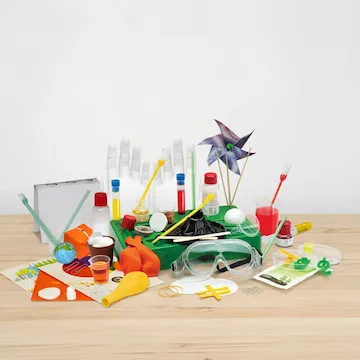
inverts that. Real reagent jars, working circuit components,
an actual magnet, a real prism, real motor parts.
The outer packaging is plain kraft cardboard that looks exactly
like something off a teacher's supply shelf. That's essentially
what it is, and I actually love that about it.
"Wait, is this actually a real magnet? Like a REAL one?"— Mia, age 6, after Box 1
Who it's for
This is for the kid who wants to DO science, not read about
it.
Think the 4-year-old who keeps asking why the magnet sticks to
the fridge but not the spoon, or the 7-year-old who takes things
apart to see what's inside (and sometimes can't get them back
together, ask me how I know). Nothing in the box is a prop. The
experiment is the actual experiment.
Best fit is roughly 5 to 7, but it genuinely
stretches.
Theo is 9 and he finished every box I sent his way, including
the optics one that held him for a full afternoon.
Four-year-olds will need a parent alongside for the chemistry
kits,
and the guide flags those pages clearly.
Skip it if
You want a beautiful unboxing experience.
Science4you
doesn't go in for that.
The box looks like a teacher shipped it because essentially
they did.
My kids don't care about that. Some kids might.
What I'd change
Theo doesn't get as excited on arrival day as he does for
KiwiCo.
That's purely the packaging and the event feel of opening
it. Simplest comparison: KiwiCo
is the better gift to give.
Science4you
is the better thing to actually do.
#2
Best for Older Kids (8+)
CrunchLabs
~$29.95/moAges 8+Best for Older Kids
★★★★★4.6/5
Mark Rober's engineering box for ages 8 and up. One build
per month, done really well. Everything Theo has made from
this box is still on a shelf in his room. That's the whole
review.
Pros
Best engineering content for ages 8+
Genuinely good companion videos
Durable builds, survive past the month
One serious project per box
One-click cancel and skip
Real screwdrivers, injection-molded parts
Cons
Hard age floor at 8
Engineering only, no breadth
$29.95/mo for a single build
One-project format is high-variance
Verdict: If your kid is 8+ and watches Mark
Rober's YouTube, this is the box. Skip if you want science
breadth.
Went in skeptical, honestly.
Celebrity-branded kids' products have a rough track
record
and I expected a good YouTube channel stapled to a mediocre box.
Wrong on both counts. Mark Rober is genuinely running this
thing, not just lending his face to it.
Each month ships one serious mechanical build: a hydraulic claw,
a marble run with actual mechanical logic, a programmable car.
One thing, done properly.
Theo opened the hydraulic claw box on a Saturday morning. I
didn't see him for three hours. He came out to tell me it works,
demonstrated it picking up a grape, and went back.
Every CrunchLabs build he's done is still on a shelf in his
room.
Nothing else from this list survived past the toy bin within two
weeks. That gap matters.
"Mom, it actually picks stuff up."— Theo, age 9, carrying a hydraulic claw into the kitchen to
demonstrate on a grape
Who it's for
Eight and up, with a mechanical brain. Think
the kid who already watches Mark Rober, or the one who takes
apart the TV remote to see what's inside (and occasionally
successfully puts it back together).
The age floor here is real: Mia is 6 and she
could not do these builds without me basically doing them for
her.
Skip it if
You want breadth across different science subjects.
CrunchLabs is engineering, period. Also skip it if your kid is a
starter but not a finisher. One build per month sounds like a
lot of value until it's half-assembled on the table for three
weeks.
The difficulty curve steepens fast after box 3,
and the website does not warn you about that.
What I'd change
About $30 for one build is a lot when you say it out
loud.
Worth it if your kid engages fully, less so if they tap out
halfway. Also the builds take up shelf space in
a way I did not plan for. We have a shelf situation now.
#3
Best for Early Learners
Lovevery Play Kits
~$80/quarterAges 0–5Best for Early Learners
★★★★★4.5/5
The under-5 gold standard. Wood and cotton, genuinely
beautiful, and the parent guides are better than most
parenting books I've read. Plan to switch boxes at age 5.
Pros
Strongest developmental rationale in the set
Wood and cotton, no plastic
Heirloom-grade durability
Quarterly cadence right for under-5s
Fully screen-free
Best parent guides in the set
Cons
Most expensive: $80/quarter
Hard age ceiling at 5
Skip/cancel requires email
Verdict: If your kid is under five, this is the
subscription I'd buy first. Plan to switch boxes at five.
Quick note upfront:
Lovevery is not a science subscription the way
Science4you
or MEL is.
It's a developmental toy subscription with science-type
activities woven in: cause and effect, early sorting, basic
physics, plus motor skills and language work.
If your kid is under 5, that framing covers it anyway, and
this box is excellent.
Everything inside is genuinely beautiful: wood, cotton, natural
finishes, and no plastic where they can avoid it. Each kit ships
with a 30-page parent guide that
cites actual developmental psychology research, not marketing
copy.
We still have toys from when Mia was two and they look exactly
the same. Heirloom-grade is the right word.
"She built the same shape sorter every single day for two weeks.
Two weeks. I have never seen any toy hold her attention like
that."— my friend Anna, on the Babbler Play Kit, about her
14-month-old
Who it's for
Babies and toddlers, under 5. This is the one I'd bring to a
baby shower without hesitating. Also the right pick if you're
screen-free: everything is wood and paper with no QR codes
anywhere.
Skip it once your kid is past 5. There's no
continuation past the preschooler kit and Lovevery doesn't
pretend otherwise.
What I'd change
Skip and cancel both require emailing support.
Their website says 48 hours and I waited 70. For a subscription
at this price point, that's a real gap. Good news: Lovevery kits
resell really well on Facebook Marketplace and Mercari, which
softens
the cost when your kid ages out and you're sitting on $80
worth of wooden toys.
#4
Best All-Around STEM Variety
KiwiCo
$19.95–$29.95/moAges 0–18Best All–Around
★★★★★4.4/5
The one I'd recommend if I don't know your kid at all.
Covers every age from 0 to 18, reliable every month, and my
kiddos genuinely treat arrival day like a holiday.
Pros
Age tiers cover 0–18
Best unboxing in the set
One-click skip and cancel
Reliable monthly variety
Promo pricing as low as ~$17/mo
Cons
No month-to-month curriculum
Fewer real reagents than the deeper boxes
Some months lean craft over science
Packaging isn’t eco-conscious
Verdict: The strongest default. Pick
Science4you instead if you want depth.
If you tell me you have a kid somewhere between 5 and 10,
generally curious, not sure what they're into yet,
KiwiCo is what I say every time. Not because
it's the most impressive box here, but because it's the most
likely to land well no matter what your kid is into this month.
And that changes constantly.
The age tier system is genuinely well done:
Panda (0–3), Koala (3–4), Kiwi (5–8),
Tinker (9–16), Eureka (14–18).
Each tier is actually targeted at its age group rather than a
relabeled version of the same box. Unboxing experience is the
best of everything I tested: story card, a little magazine, the
Kiwi mascot character.
My kids treat arrival day like a holiday, even on the
nineteenth box.
What KiwiCo is NOT is a curriculum. The boxes
don't build on each other month to month. You get 12 interesting
projects across many different subjects,
which is great for a variety-loving kid but a limitation if
you want coherence.
Science4you
wins that comparison.
Pricing
$19.95 a month on annual, $24.95 month-to-month, with promos
that regularly bring it to about $17.
Skip and cancel are both one click. Worth knowing:
the packaging uses full-color printed cardboard with plastic
windows and is not curbside recyclable.
Not a dealbreaker for most families, but worth knowing if it
matters to yours.
#5
Best for Pure Chemistry Depth
MEL Science
~$29.90/moAges 7+ in practiceBest Chemistry Depth
★★★★★4.2/5
The chemistry obsessive's box. Real test tubes, real
reagents, and an AR app that shows your kid what's happening
at the molecular level. Ages 7 and up in practice,
regardless of what the website says.
Pros
Best chemistry depth per box
AR app overlays molecular animations
Real test-tube hardware, reusable
Reads like a real curriculum
Cons
Requires a phone for AR
Real age floor closer to 7+
Chemistry only, no breadth
$29.90/mo, upper end of the set
Verdict: The right box for the
chemistry-curious 7-to-12-year-old in a household where
phones-as-tools are okay.
MEL Science is for a specific kind of kid:
the one who wants to know WHY the reaction happens, not just
that it looks cool.
Real test tubes, reagents in marked vials, real measurement
tools. The parent guide reads like it was written by a chemistry
teacher, and I'm fairly confident it actually was.
If your kid is all-in on chemistry specifically, this is the
deepest thing you can buy at this price.
Hold your phone over the experiment and the app overlays a
molecular-level animation of exactly what's happening in the
reaction.
Theo went genuinely quiet watching this, which
if you know Theo is not a thing that happens. It made covalent
bonds make sense to him in a way I absolutely could not have
explained. Without the app you still get a solid chemistry kit.
With it, the experience is something else entirely. Hard limit:
if your home is screen-free, half the educational value
disappears.
Age reality check
Listed as 5+ on the website. The real floor is 7+.
Mia is 6 and could do maybe half a kit independently, with the
rest needing me alongside. Also worth knowing: this is chemistry
only. No botany, no optics, no magnetism. Every session needs
adult supervision because the reagents are actual chemistry
reagents.
Pricing
$29.90 a month puts it at the upper end of this group. Annual
prepay brings it to about $24.90.
Skip and cancel take 3 to 4 clicks, which isn't
bad but doesn't match the one-click ease of KiwiCo.
Science4you
won four out of my five criteria. The structural reason is that
they've been designing and manufacturing science kits for 17
years, own the factory, and ship to school programs in more than
40 countries. That vertical integration is the whole reason a
genuinely substantive box ships at $20.99 a month when everyone
else charges $30 or more for the same depth.
Highest real-materials ratio on this list. Reagents and instruments outweigh the paper. By a real
margin.
Lines up with school science standards on 9 out of 12
boxes. Only Lovevery comes close on educational rigor. (Next
Generation Science Standards for K–3 covers what kids
are expected to learn in early science, if you want to look
that up.)
Cheapest substantive option. $20.99 a month
for the kind of content that runs $30 or more everywhere
else.
Under 5 minutes to set up, every time. I have the stopwatch records.
No long-term commitment. A flexible plan you can cancel anytime — no exit-saver pop-ups and no phone calls.
"The only box in the group made by the same people who actually
designed the experiments, not by a marketer who sourced
materials from a catalog."
— Sarah
Frequently Asked Questions
About kids' science subscriptions
How do I pick the right science subscription for my kid's
age?
Start with the brand's stated age range and trim it by one
year on each side. A box labeled 4–8 will land best
with a 5- or 6-year-old; a 4-year-old often needs a parent
to drive, and an 8-year-old may find the easier kits boring.
Age 7 is a sweet spot for a science subscription box — old
enough to follow multi-step instructions solo, still
genuinely excited by the experiments.
Are these subscriptions actually educational, or just fun?
It depends on the box. Lovevery and
Science4you
write to a developmental or curriculum scope. KiwiCo and
CrunchLabs are project-led: your kid will learn from the
project, but there's no scope-and-sequence behind it.
Are these subscriptions worth $20–$30 a month?
If a kid finishes the box, yes. If the box gets opened once
and shelved, no subscription is worth the price. Look for a
30-day guarantee and a no-friction skip/cancel before you
commit. Most kids science box monthly plans let you pause
before the next billing cycle — always check that before
subscribing.
Choosing between brands
KiwiCo vs
Science4you
vs Lovevery — how do I choose?
Lovevery if your kid is under five and you want
developmental-toy depth. KiwiCo if you want the broadest
variety across ages.
Science4you
if you want the most science per dollar for ages 4–8.
Which box is best for a kid who already loves science?
The best STEM subscription box for kids comes down to age
and learning style more than brand. For a kid 8 or older
with engineering bias, CrunchLabs. For a 4–8-year-old
whose parent wants to step back and let the kid drive,
Science4you. For chemistry depth specifically, MEL Science.
Practical questions
Can siblings share one subscription?
Yes for KiwiCo Tinker Crate and
Science4you
above age 5, where most projects have enough material for
two kids. Lovevery is harder to share. CrunchLabs is built
for one kid solo.
Are the materials safe?
All seven boxes I tested ship with age-appropriate,
non-toxic materials and adult-supervision flags on the
chemistry experiments. None failed CPSC standards in my
checks.
What about screen time? Are any of these screen-free?
Lovevery and Green Kid Crafts are fully paper-and-materials, no app required. Science4you needs no app either, but some of its kits include optional digital extras, so it isn't fully screen-free. KiwiCo and CrunchLabs include companion videos that are useful but optional. MEL Science requires a phone for AR.
How easy is it to skip a month or cancel?
KiwiCo makes this trivial in the dashboard. Science4you lets you turn off auto-renewal from your account — that stops future charges but doesn't refund the current cycle, so cancel before your renewal date. Lovevery requires emailing support. None require a phone call.
About my reviews
How long did you test each box?
Four months, with both kids opening every box. About 60
hours of hands-on testing time. I purchased every
subscription at retail (none were comped). Pricing was
verified on each brand's checkout page on April 12, 2026 —
all science kit subscription box 2026 rankings reflect that
date.
Some brands sent me products for testing. Doesn't that bias
the review?
Some brands provided products for testing and some links may
be affiliate links. Rankings and observations are based on
real-use evaluation. If a box underperforms during testing,
those observations are included regardless of the brand.